If I had to collect a list of 3 things that would impress locals if you already knew about when you visit Colombia they’d be salsa, aguardiente and Carlos Vives. Yup, even more useful than knowing the language. Seeing as I’ve written about salsa and aguardiente here on our Colombia Travel Blog, I think it’s nigh time I wrote a little about the Colombian legend that is Carlos Vives.
Vives was born and raised in Santa Marta, Colombia, where he lived until the age of 12. It was then he moved to Bogotá and became emerged in the city’s lively rock scene. Using influences from this scene Vives realised the potential to revamp traditional, local music styles in order to broaden their appeal. Initially, however, his albums flopped owing to their sentimental nature – the majority of the songs were ballads.

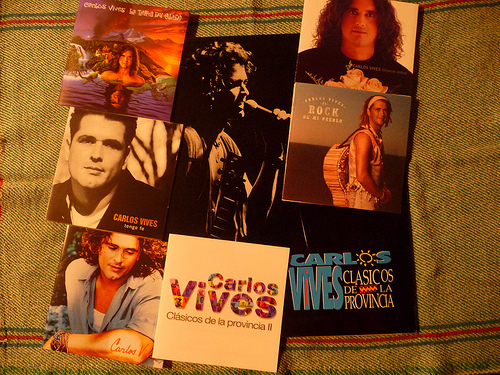
It took a move to Puerto Rico and a subsequent return to Colombia to provide Vives with the winning formula for his music. Influenced by his role as famed vallenato singer Rafael Escalona in the telenovela Escalona, Vives began rooting his music more firmly in the vallenato style. Come 1993, Vives had found the winning formula for his music, fusing vallenato, rock, pop and other Caribbean influences in his album Clásicos de la Provincia. The lead single of this album, ‘La Gota Fría’, became an international hit and the album won the Best Album Award at the Billboard Latin Music Awards.
Check out two of my favourite tracks below: the questionably-messaged but catchy ‘La Celosa’ and Vives’s cover of ‘Jaime Molina’.
Paul






Pingback: Movember Special: Great Moustaches of Colombia. | Colombia Travel Blog by Marcela & See Colombia Travel
Pingback: Top 10 Songs of 2011 by Colombian Artists | Colombia Travel Blog by Marcela (and the See Colombia Travel team)
Pingback: FROM THE ARCHIVES: Marcela's Top 5 'Rumbeaderos' in Bogotá | Colombia Travel Blog by Marcela (and friends)
Pingback: Bomba Estereo | Colombia Travel Blog by Marcela (and friends)
Eduardo on
Desde aquí, la Gran Manzana de NYC, mando saludos a todo el mundo que sepa lo que significa Carlos pa todo el mundo musical de habla Hispana.
Carlos Vives es un hombre con raíces. No le ha cambiado mucho ni la fama, ni el oro, ni la adulación de un pueblo entero. Sigue siendo el mismo muchahón Samario, devoto a su equipo la Unión del Ciclón Bananero, al acordeón, y a la gran herencia de música de su región de la Guajira y de Valle Dupar. Con Ergidio, Mayté, y su tropa, ha sacado una obra musical que ha dejado honda huella en Colombia, y en todas las comunidades Hispanas del mundo. Yo conocí su música por unas amigas Colombianas, (Gracias, Giselle!!) y he seguido su carrera con gran afán.
Los corridos, paseos, merengues y composiciones de Vives, del gran Maestro Alejo, de tantos artistas que toman parte diaria de mi vida en my iPod y en mis viajes al trabajo son ahora una fuente de gran satisfacción musical. Supongo que no soy el único, verdad?
Para mi la mejor canción de Vives, la que reúne su alma romántica, sus anhelos, sus quebrantos, sus amores, sus deseados porvenires, sus valores, es “Déjame Entrar”.
Cuadrado lo acompaña con una línea de melodía asombrosa, Mayté contribuye ese sonida de flauta indígena sin igual, la guitarra y la batería saben de qué se trata la canción, y la letra describe lo que es amar un mujer, y poner en ella toda las esperanzas de un corazón de hombre.
En la canción, esa mujer va “Pariendo Sueños”.
Sí, Carlos, y tu los crías.
Eduardo.
Eduardo on
Oops, just realized these posts are in the King’s English??
OK, I can do that.
Writing to you all from NYC, the Big Apple, I embrace all those who understand what Carlos Vives has meant to the music of the Spanish-speaking world.
Carlos Vives is a man with deep roots. Neither fame, nor money, nor the adulation of a whole people has changed him very much. He is still the same Samarian big kid, devoted to his town’s Unión football team, to the acordeón, and to the great musical heritage of his province, La Guajira, and its great city Valle Dupar. With Ergidio, Mayté, y his troupe of musicians, he has developed a body of work that has left a deep imprint in Colombia, and in all the Hispanic communities around the world.
I got to know his music thanks to some Colombian friends, (Thanks, Giselle!!) and I’ve followed his career ever since.
The corridos, paseos, merengues and songs of Vives, the gran Maestro Alejo, of so many artists who take part in my daily life in my iPod and my commutes to work are now a great fountain of musical satisfaction. I do suppose I’m not the only one who feels this way, right?
To me, Carlos Vives’ greatest song, the one that puts together his romantic soul, his yearnings. his disappointments and breakdowns, his romances and loves, his best hopes for the future, his values is “Déjame Entrar”.
Cuadrado accompanies him with an amazing line of melody, Mayté contributes with that haunting, incomparable native flute, the guitars and percussionist understand what this song is about, and the words describe what it is to truly love a woman, to pour into her all the hopes a man’s heart has.
In the song, that woman goes “Giving birth to dreams”
Yes, Carlos, and you take care of them and raise them.
Edward
Pingback: Carlos vives | Firstquantumre
Michelle on
Perfectly written article. I always enjoy these blogs. Continue educating, inspiring and spreading the word of all the beauty Colombia has to offer. Viva Colombia! Mi Tierra querida.
*LA VIDA ES SAGRADA…….EL SECUESTRO LA DEGRADA*
Paul on
Thanks Michelle for your kind words, it keeps us motivated to continue doing what we’re doing. Saludos!
Paul
Annika i Colombia on
Carlos Vives is great, but “La celosa”? Really? It is probably the most sexist and male-violence-against-women-glorifying song ever written in the Spanish language.
PS My personal favourite is “Jaime Molina” (although the Carlos Vives version is only a cover of Rafael Escalona’s original)
Paul on
Yeh I’m afraid I got into ‘La Celosa’ before I knew any Spanish, so I just found it catchy musically and it was only later I began to understand what he’s singing about, but I was already hooked to the song. Anyway, I’ve updated to take into account your recommendation and the dodgy nature of the lyrics, I hadn’t thought about it before, thanks!
Paul
Annika i Colombia on
Thanks, that explains it! 🙂
Valentina on
Annika: although the idea is not to promote sexism or violence, I must say that “La Celosa” by Carlos Vives is a legendary song that’s just cheeky and you might even say naive. All Colombian girls have sung it to a jealous boyfriend and vice versa in a funny way. And if we are gonna criticize “La Celosa” then we would also be deprived of most hip hop, rap, vallenato, rancheras, many of pop and even some rock and reggae music.
And of course permanently remove regueton of our lives.
In a perfect world we all have nice and clever songs, but most the Latins are more about rhythm and movements than lyrics.
I love Jaime Molina too, good song about friendship.
Good post Paul!
Michelle on
@Valentina: well said. i agree.