
Aside from the slang phrases in Colombia, there are some rather strange things about Colombian Spanish that can make it confusing for foreigners – even those that have Spanish as their first language.
Colombian Spanish has always been a very formal way of speaking. Friends refer to each other as ‘usted’, and people don’t say ‘what?’ or even ‘pardon?’, they say ‘señor?’. It all adds up to a very polite society, with some very curious turns of phrase.
1. “Que pena con usted”
One of the most frequently heard sentences in Colombia, Colombians use ‘que pena con usted’ in the way that English people use ‘sorry’, which is to say it’s as much out of habit as it is out of genuine remorse. Not a bad thing, since considering the amount you hear it Colombians would be spending most their time feeling bad for pretty insignificant wrong-doings (like accidentally bumping in to you).
2. Que pecao!
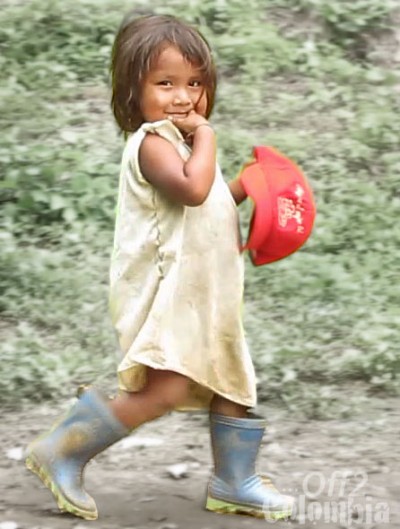
Literally translating to ‘what a sin’, Colombians actually mean this one like we English folk might say ‘bless your cotton socks’. Someone’s hurt? Use it. Little boy crying? Use it. Cute little baby? Use it! You may infer, then, that this is a mumsy saying, and you’d be right. Bless.
3. Su merced
‘Your mercy’. People will actually, genuinely, really call each other that (although not the younger generations).
4. Juemadre
The rage is building up inside of you but you’re not in appropriate company to swear, so what do you do? You soften the blow of the classic ‘Jueputa’ (‘hijo de puta’), and change it to ‘juemadre’, or ‘son of a mother’. Clearly more acceptable. Also an adequate substitute: ‘juepucha’, which means absolutely nothing.
5. Me regalas…
So normal is ‘me regalas’ in Colombia that you can quickly forget you’re actually asking people to give you stuff for free, before actually paying them. A strange turn of phrase that will sound pretty odd if you travel elsewhere and use it…
Bonus: Con Gusto
‘Con gusto’, ‘con mucho gusto’, ‘con muchisimo gusto’. These are all very common and, like ‘que pena…’ are pretty much used habitually, in the same way you just say ‘no worries’, or ‘you’re welcome’. Considered extremely polite in most other Spanish speaking countries (some of which won’t even use ‘de nada’), it can sound a little odd to the newcomer to Colombia, but as with most of these phrases, they’re just relics of a time when things were far more formal here. These days people are a little more relaxed.
So cogela suave, hombre.
Paul




Pingback: Monotype Brief Development | isabellagraphics
Pingback: Colombinglés - The Colombia Travel Blog's Definitive Guide to Colombian English | Colombia Travel Blog by Marcela & See Colombia Travel
Pingback: Bogota: The Seoul of South America? | Colombia Travel Blog by Marcela & See Colombia Travel
website on
This is very fascinating, You’re an overly skilled blogger.
I’ve joined your feed and sit up for looking for more of
your excellent post. Also, I have shared your site in my social networks
Eduardo on
Well, something that few people really knows, is that ‘ju’e’madres were the sons that were not recognized by their fathers, so they didn’t gave them the right to use their last name, because they were children out of the marriage. So “juemadre” really means bastard and it was a hard insult. It was used with its real meaning in the period of colombian history called “La violencia” and perhaps much before.
Pingback: Travel to Colombia Without Speaking Spanish? | Colombia Travel Blog by Marcela & See Colombia Travel
Meg on
Being Colombian, and being raised in the US, I can say I miss my country, Que Viva Colombia is a very used phrase, will be back soon.
Pingback: The Top Most Visited Colombia Travel Blog Posts of 2012 (So Far) | Colombia Travel Blog by Marcela (and the See Colombia Travel team)
Steve on
I’ve been visiting Colombia regularly for the last 10 years, doing lots of photography, especially in El Chocó. I love Colombian Spanish, but I think you should be careful not to assume that what’s said in Cundinamarca or Boyacá is necessarily the same throughout the country. For example, in the Pacific I never hear Su merced, and people do very commonly say “¿Cómo?”as well as “¿Señor?”
Other common Colombian expressions: “siga” for what would be “pase” or “adelante” in other countries; “”afán” for “prisa”…
Tally on
Estoy piedro o me sacaron la piedra, to say I’m angry.
Jaime Buendia on
Colombians are great people! We use terms like “Berraco” quite a bit. It literally means reproductive pig. we use it as a noun– Que berraco tan mamon! Adjective–Que arbitro tan berraco! Adverv–Que fiesta tan berracamente buena! to show anger– estoy enberracao! compassion–No te enberraques conmigo por favor! also la “baina” The thing– Que es esa baina? don’t bother me anymore–“No me jodas mas” and many others. Que viva Colombia carajo!
Jim Buendia on
We Colombians say lots of interesting stuff!! One of our favorite words is Berraco!! which literally means a pig designated for reproductive purposes because he is of such “casta” The equivalent to a “stud” in English. we use it as a noun– Que berraco tan chevere! Adjective– Que vieja tan berracamente linda! Adverb–Que partido tan berracamente bueno! We use it to show anger–Estoy berraco con tigo mi amor! and in many other ways like– Que fiesta tan berracamente buena, conoci a una viejas la berraquera y una de ellas se emberraco con mi amigo! Que viva Colombia carajo!
Julia on
Some of these made me giggle…juemadre, just like in English!
Paul on
You should check out some of the posts about slang!
Michelle on
Hijueputa!
Jajaja!
Paul on
Naughty naughty! A very Colombian pronunciation, if not only Colombians say it!