
Recently we brought you 1-5 of our top 10 Colombian fruits. Today we’re finishing the list, but it has to be said, there’s so much variety here in Colombia and the fruit is so delicious that you almost can’t go wrong. If you’re traveling to Colombia, just remember to be adventurous with your smoothies. The less you understand what the menu says, the better.
Carambola / Star fruit

The truth is even if I didn’t love the taste of carambola it’d still find its way onto this list because it’s shaped like a star! Now, unfortunately I don’t live in Mushroom Kingdom and my name isn’t Mario, so when I eat carambola music doesn’t start playing, I don’t turn invincible, but I do get a tasty punch of a kind of citrus-y, apple-y mixture. The texture’s also very satisfying, not unlike a grape but slightly crunchier and very juicy. A delightful treat.
Tomate de árbol / Tamarillo
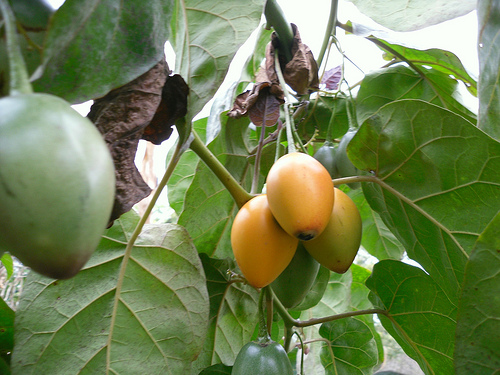
Another smoothie classic. I don’t tend to eat tomate de árbol straight, for no other reason than I have a habit of heading to my local smoothie vendor in the morning and getting myself a delicious, hearty drink. Of course, you can eat it by itself and no doubt you’ll enjoy it, I just believe you can have too much of a good thing, so I limit myself to once-a-day. Tomate de árbol tastes like a mix between kiwis and tomatoes, and is easily sweetened with a little sugar. Like lulo, it’s very popular with locals and so it’s a must-try when visiting Colombia.
Guanábana / Soursop
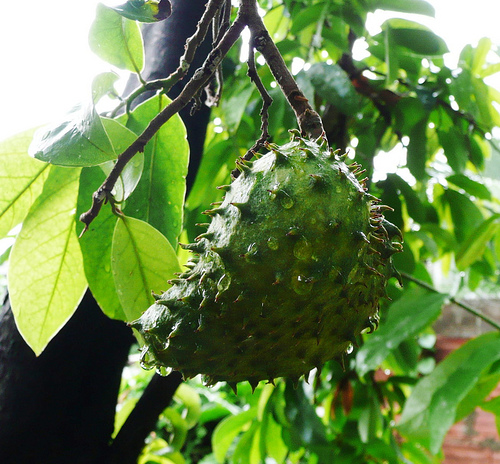
Texture-wise, the guanábana can take some getting used to. Its exterior is soft and spikey while inside it’s reminiscent of custard, but not the thick, lumpy custard like dad makes. You know, the good, smooth kind, like your mama makes you. The taste is kind of acidic and if the fruit isn’t ripe it can taste pretty weird, but when you get the right guanábana it’s like a cacophony of fruity goodness, mixing strawberry, banana and citrus with a hint of coconut, just for good measure. And yup, you guessed it, it makes a great smoothie.
Pitaya / Dragon fruit

I first discovered this fruit in Sri Lanka and was thrilled when, on my first Colombia vacation, I discovered it was available here too. I admit my immediate attraction to pitaya is the fact that it’s the most colorful fruit I’ve ever laid eyes upon. Its exterior is bright pink with dashes of green, and when it’s cut open it’s a deep pink with black seeds. Pitaya in South America is slightly different to its Asian cousin (which on the inside looks like cookies & cream ice cream), but still just as nutritious and delicious.
Banano / Banana & Piña / Pineapple

Ok so it’s hardly like you won’t have heard of pineapples or bananas, but they deserve a brief mention because, like any food, they taste so mouth-watering here because you’re eating directly from the source. No two-three day delay between being farmed and arriving in your local supermarket, they’re sold out on the street a few hours after being picked. A special mention must go to the smoothie lady on Playa Grande in Taganga, who made the best banana smoothie this young man has ever tasted. Props to you, smoothie maestra.
Paul


Pingback: Food and Travel: is food our main reason for travelling? | Colombia Travel Blog by Marcela & See Colombia Travel