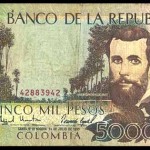
Colombia’s local currency is the Colombian Peso. Initially things can get a bit confusing since the lowest note available is 1,000, but you soon become accustomed to the extra zeros and, frankly, I’ve never felt richer. The exchange rate is officially rated against the US Dollar and varies daily, but for a rough estimate as you wander round you ignore the last two zeros, then for USD divide by 2, for Euros by 2.5 and for pounds by 3. For an official exchange rate, be sure to consult the currency calculator over at X-Rates.com.
Coming from the UK it was almost impossible to exchange local currency for Colombian Pesos, so if you’re due to arrive from a country in Europe fear not – upon arrival exchanging your money is easy. From the US most airports will exchange your money for you. ATMs are also found in abundance here in Colombia, especially in bigger cities such as Bogotá, Cartagena and Medellín, so if you don’t mind the relatively small charge, you can just take money out once you arrive. Most restaurants and shops also accept card, so you should find splashing the cash dangerously easy in Colombia.
It’s possible to exchange money on the street, but we strongly advise against it and recommend only using a bureaux de change, bank or hotel. Receiving false money isn’t common, but it’s certainly not unheard of in more popular tourist areas such as Cartagena. Be vigilant. To tell if a note is real you can touch the images and you should feel a slightly bumpy texture. If your note is completely smooth, I’m afraid it’s likely you’ve been duped.
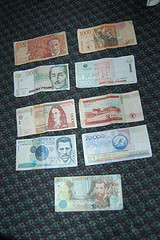
Colombia has $1,000 $2,000 $5,000 $10,000 $20,000 and $50,000 denomination notes and $20, $50, $100, $200 and $500, $200, $100 and $50 pesos coins. They’re all pretty distinct except for the $1,000 and the $10,000 which are both brownish… It’s led to some pretty red faces while I’ve been here with my friends and, as yet, I haven’t managed to pay $1,000 for something that’s worth ten times more, so maybe it’s just us gringos that get confused…
Ryan